Book Your Free Consultation Today
Get expert guidance from certified specialists. Fill in the form and our team will call you back within 24 hours — completely free, no obligation.
Book a Free Consultation
We'll call you within 24 hours. Your details are safe with us.
Audiologist Near Me: How to Find the Right Hearing Specialist
If you have typed “audiologist near me” into a search bar, chances are you or someone you love is struggling to hear clearly. Maybe the TV volume keeps creeping up, or conversations in a crowded room have become exhausting. Whatever brought you here, taking the first step is the hardest part, and you have already done it.
Hearing loss is one of the most common health concerns in India, yet many people wait years before getting their ears checked. Early diagnosis protects your communication, your relationships, your work and even your brain health. The key is finding a qualified audiologist who is close, trustworthy and genuinely focused on your needs. This guide explains what an audiologist does, when you should visit one, and how to choose the best hearing care professional in your area.
What Is an Audiologist? (ऑडिओलॉजिस्ट म्हणजे कोण?)
An audiologist is a trained healthcare professional who diagnoses, manages and treats hearing loss, balance problems and related ear conditions. Unlike a general physician, an audiologist specialises entirely in the auditory system. They use advanced equipment to measure how well you hear, identify the type and degree of hearing loss, and recommend the most suitable solution.
Audiologists work with people of every age, from newborns who need hearing screening to older adults who need hearing aids. In India, a qualified audiologist usually holds a degree in audiology and speech-language pathology and is registered with the Rehabilitation Council of India. Always check these credentials before booking.
Audiologist vs ENT Doctor vs Hearing Aid Dealer
Many people are confused about whom to visit first, so here is a simple breakdown.
An ENT doctor is a medical doctor who treats diseases of the ear, nose and throat, including infections, perforated eardrums and surgical conditions. An audiologist measures hearing, interprets the results and manages hearing loss through devices and rehabilitation. A hearing aid dealer sells devices, but may not have clinical training to test your hearing properly.
For most hearing complaints, an audiologist is the right first stop. If your audiologist suspects a medical or surgical condition, they will refer you to an ENT specialist. The best clinics work with both professionals, so you get complete care under one roof.
Signs You Should See an Audiologist (कानाची तपासणी कधी करावी?)
Hearing loss usually develops slowly, so you may not notice it at first. Consider booking an appointment if you experience any of these signs:
You often ask people to repeat themselves. You find it hard to follow conversations in noisy places like restaurants, weddings or markets. You turn up the TV or phone volume higher than others prefer. You feel that people mumble when they speak. You have ringing, buzzing or hissing in your ears, known as tinnitus. You feel fullness or pressure in your ear. You experience dizziness or imbalance. You have trouble hearing on the phone. Your child is slow to speak, does not respond to sounds or struggles at school.
Even one of these signs is reason enough for a hearing test. Adults over 50, people exposed to loud noise at work, and anyone with a family history of hearing loss should get screened regularly.
Services Offered by a Good Audiologist
A reliable audiology clinic offers much more than a quick hearing check. Look for these core services.
Comprehensive hearing assessment: Pure tone audiometry, speech audiometry and impedance testing give a complete picture of your hearing health. The results are presented as an audiogram, a chart showing which sounds you hear well and which you miss.
Hearing aid selection and fitting: Modern hearing aids come in many styles, including behind-the-ear, in-the-ear and nearly invisible models. A good audiologist matches the device to your hearing loss, lifestyle, budget and comfort, then programs it precisely for you.
Hearing aid trial and follow-up: Adjusting to hearing aids takes time. A trial period, regular fine-tuning and cleaning support make a big difference to long-term satisfaction.
Tinnitus management: Counselling, sound therapy and hearing devices can help reduce the distress caused by constant ringing in the ears.
Ear wax removal: Excess wax is a common and easily fixed cause of reduced hearing. Safe, professional removal is far better than using cotton buds or home remedies.
Speech and language therapy: Children and adults with speech delays, stammering or voice problems benefit from structured therapy.
Balance and vertigo assessment: Some audiologists evaluate dizziness linked to inner ear problems.
How to Choose the Best Audiologist Near You
Searching is easy. Choosing well takes a little more thought. Use this checklist to compare options.
Check qualifications and registration. Confirm that the audiologist holds a recognised degree and valid registration. Do not hesitate to ask.
Look for modern diagnostic equipment. Accurate results depend on a soundproof test room and calibrated equipment.
Ask about brand variety. A clinic that offers multiple hearing aid brands can recommend what truly suits you rather than pushing a single product.
Read genuine patient reviews. Look at recent feedback on Google and local platforms. Pay attention to comments about honesty, patience and after-sales service.
Ask about trial options. A trial period of a few days lets you test hearing aids in real life before committing.
Understand the total cost. Ask what is included, such as fitting, follow-ups, warranty and battery or servicing support. Many clinics offer easy EMI options that make quality hearing aids more affordable.
Check convenience. Distance, timings and home visit availability matter, especially for elderly patients who find travel difficult. Home fitting services can be a major advantage.
Trust your comfort level. A good audiologist listens, explains clearly and never pressures you. If you feel rushed or confused, keep looking.
Questions to Ask at Your First Appointment
Going in prepared helps you get the most from your visit. Consider asking: What type and degree of hearing loss do I have? Is the loss temporary or permanent? Do I need medical treatment or only hearing aids? Which hearing aid style suits my lifestyle? What is the full cost, and what warranty is included? How many follow-up visits are included? What should I expect during the adjustment period?
What Happens During a Hearing Test?
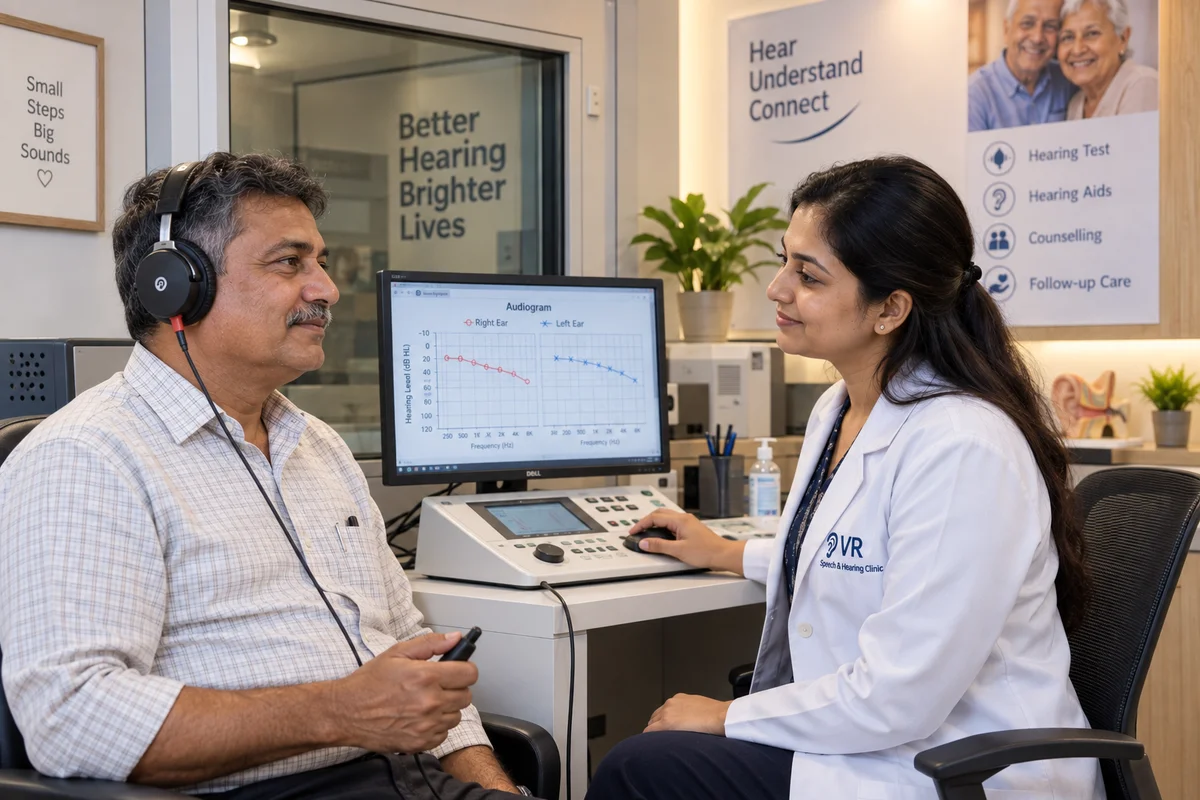
A hearing test is painless and usually takes 30 to 60 minutes. First, the audiologist asks about your medical history, symptoms and daily listening challenges. Next, they examine your ear canal and eardrum to check for wax or infection. You then sit in a quiet room wearing headphones and respond to a series of beeps and spoken words. The audiologist records your responses on an audiogram and explains the results in plain language.
If hearing loss is found, they will discuss your options, which may include hearing aids, medical referral, or monitoring over time. You should leave with a clear understanding of your hearing and a practical plan.
Why Early Treatment Matters
Untreated hearing loss does not just make life quieter. Research has linked it with social isolation, anxiety, reduced job performance and a higher risk of cognitive decline. Your brain needs consistent sound input, and when hearing fades, it works harder to fill the gaps. Hearing aids and early intervention help keep you connected, confident and mentally active.
For children, early detection is even more critical. Hearing is essential for language development, and delays in treatment can affect speech, learning and social skills.
How EarMart Helps You Find Better Hearing Care
At EarMart, we believe everyone deserves access to clear information and trusted hearing care. Our goal is to help you understand your hearing, compare your options with confidence, and connect with the right professional without confusion or pressure. Whether you are comparing hearing aid technologies, learning about tinnitus, or simply wondering if it is time for a hearing test, EarMart is here to guide you at every step.
Hearing health should never be guesswork. With the right information and the right audiologist, better hearing is well within reach.
Before you ask
The questions every new client asks in the first call. Anything else, WhatsApp us.