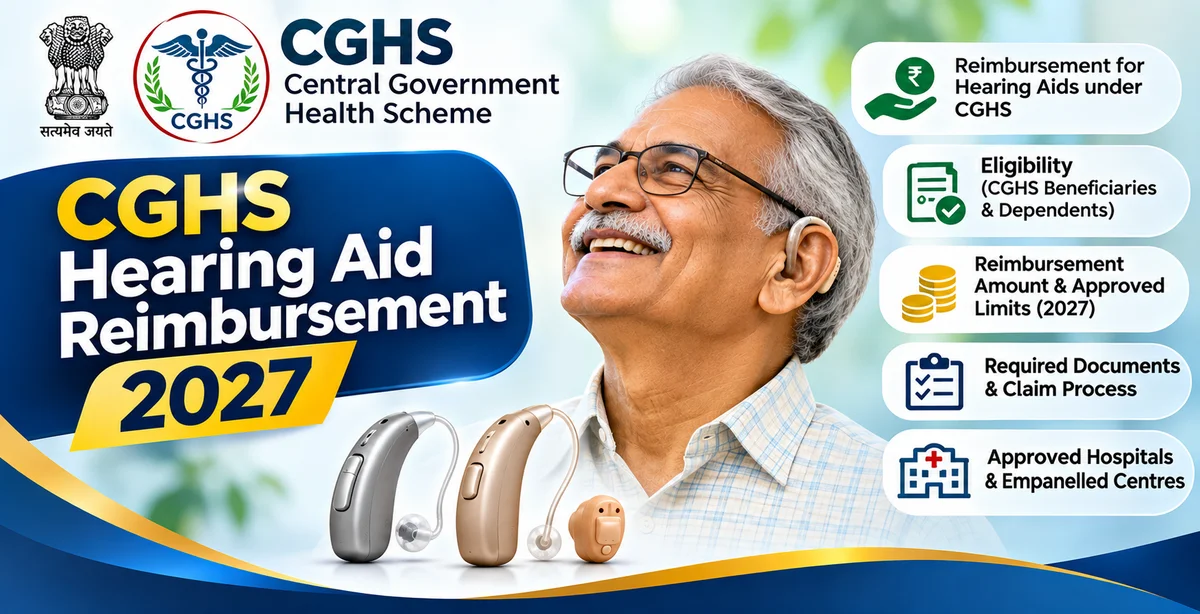
CGHS Hearing Aid Reimbursement 2027: ₹30,000 Per Ear
CGHS Hearing Aid Reimbursement (2027): Rules, ₹30,000 Ceiling & How to Claim
If you are a central government employee, pensioner or dependent covered under CGHS or CS(MA) Rules, buying a hearing aid just became far easier on your wallet. A September 2027 order from the Ministry of Health raised the reimbursement ceiling to ₹30,000 per ear, a big jump from the earlier ₹8,000 to ₹9,000 limits. But the money only reaches you if you follow the process in the right order. This guide explains the 2027 rules, eligibility, minimum specifications, documents and the exact steps to claim.
What Changed in 2027?
The Ministry’s EHS Section issued Office Memorandum S.11030/76/2026-EHS on 9 September 2026, and it replaces the earlier order dated 1 December 2020. Under that 2020 order, the ceiling was ₹8,000 for a digital BTE aid and ₹9,000 for a digital ITC/CIC aid, per ear.
The new order moves CGHS toward modern, rechargeable digital technology. It also sets minimum technical standards, so you can no longer claim for just any device.
The ₹30,000 Ceiling Explained
The maximum reimbursement is ₹30,000 per ear for a standard digital programmable and rechargeable hearing aid, covering both digital BTE and digital ITC/CIC types. You receive the actual cost or the ceiling, whichever is lower.
Key points to remember:
One ear: up to ₹30,000.
Both ears: up to ₹60,000 when bilateral fitting is clinically justified, subject to actual expenditure.
Taxes included: the ceiling already includes GST and other taxes, and it covers a complete usable package with a three-year comprehensive warranty.
For example, if your aid is billed at ₹26,500, you can be reimbursed the full ₹26,500. If it is billed at ₹42,000, you receive ₹30,000 and pay the balance yourself. Premium extras such as wireless streaming or app control do not raise the ceiling.
Who Is Eligible?
CGHS and CS(MA) beneficiaries, meaning serving employees, pensioners and eligible family members, can claim. Two conditions apply. First, a competent ENT specialist must prescribe the hearing aid after an audiometric assessment. Second, you must declare that you have not claimed hearing aid reimbursement in the preceding five years.
Minimum Specifications Your Hearing Aid Must Meet
The order lists minimum functional requirements. The aid must be fully digital, computer-programmable and a current, non-discontinued model. It needs at least eight independent frequency channels, multichannel wide-dynamic-range compression, an automatic mode plus at least three selectable programmes, directional microphones with digital noise reduction, adaptive feedback cancellation, and programmable maximum output. It must be rechargeable, with a standard charger in the package and a minimum three-year warranty on both the device and the charger.
Ask your audiologist to confirm in writing that the model meets these points. You will need that proof later.
How to Claim: Step-by-Step Process
Step 1: Get a referral. A Medical Officer at your CGHS Wellness Centre refers you to an ENT specialist.
Step 2: Get the ENT prescription and audiogram. The specialist recommends a hearing aid based on audiological testing, and the recommendation must be brand-neutral. Carry your original CGHS card to every visit.
Step 3: Obtain permission before buying. Pensioners get permission from the Additional Director of their CGHS city. Serving employees and autonomous body staff get it from their Head of Department or Office. Never buy first and ask later, because a purchase without prior permission can be rejected.
Step 4: Submit the undertaking. This is the Annexure-II declaration confirming no hearing aid claim in the last five years, plus your acceptance of the ₹30,000 ceiling.
Step 5: Buy from a qualified seller. Make sure the invoice carries the seller’s details, registration number, device serial number and GST.
Step 6: File your claim. Submit the medical reimbursement claim form with all documents. Under the earlier order, pensioners filed through the CMO in-charge of their wellness centre, and serving employees filed through their own office. Confirm the current channel locally.
Documents Required
Keep these ready: the wellness centre referral letter, the ENT prescription with an authenticated audiogram report, a copy of your CGHS card, the original bill or tax invoice, the original permission letter, the empty box or carton with its original label, evidence that the aid meets the minimum specifications along with the fitting and programming record, and the three-year warranty certificate.
Do not throw away the box. Claims have been returned for missing cartons.
What Is Not Reimbursed
There is no separate payment for GST, the standard charger, fitting, programming, verification, counselling or routine maintenance, because these are all folded into the ceiling. Body-worn, pocket-type and analogue BTE aids remain excluded. After the warranty ends, maintenance, batteries and consumables are your responsibility.
Replacement Rules
A replacement is allowed only after five years from the date of purchase or reimbursement, and you no longer need a condemnation certificate after that period. Plan your purchase carefully, since you cannot claim again for half a decade.
Common Mistakes to Avoid
Buying the hearing aid before permission arrives.
Choosing a model that is not rechargeable or lacks the required channels.
Paying separately for fitting and programming and expecting it to be reimbursed.
Submitting a photocopy of the bill instead of the original.
Losing the empty box or warranty card.
Final Thoughts
The 2027 revision is a genuine relief for CGHS families, but it rewards preparation. Get the ENT prescription, secure permission first, buy a compliant rechargeable model, and keep every document. Rules and procedures can be updated, so check the latest order with your wellness centre before you purchase.
Frequently Asked Questions
1. What is the CGHS hearing aid reimbursement limit in 2027?
It is ₹30,000 per ear, inclusive of GST, or the actual cost, whichever is lower.
2. Can I claim for both ears?
Yes, up to ₹60,000 if bilateral fitting is clinically justified and supported by actual expenditure. .
3. Do I need permission before buying?
Yes. Permission comes from the Additional Director of your CGHS city if you are a pensioner, or from your Head of Department or Office if you are serving.
4. Are rechargeable hearing aids mandatory?
Yes, the power source requirement is rechargeable, with a standard charger included in the package..
5. How often can I claim?
Once every five years. A replacement is allowed only after five years..
6. Will premium features like Bluetooth increase my reimbursement?
No. Optional premium features do not earn additional reimbursement.
7. Are the old ₹8,000 and ₹9,000 rates still valid?
No. The 2026 order supersedes the 2020 rates for hearing aid reimbursement under CGHS and CS(MA) Rules.