Government Schemes for Hearing Aids in India
Yes, there are government schemes for purchasing hearing aids in India, and many families never hear about them. Hearing instruments can cost anywhere from a few thousand rupees to several lakhs, so price is often the biggest barrier to better hearing. The good news is that central programmes can cover part or all of the cost for eligible people, while reimbursement rules, a GST exemption and an income-tax deduction ease the burden further.
This guide explains each major route in plain language: who qualifies, how much support to expect, which documents you need and what to do if you fall outside the limits. Rules and income ceilings are revised from time to time, so we have flagged the points worth confirming before you apply.
Quick Answer: Which Government Schemes Help You Buy Hearing Aids?
Five routes matter most:
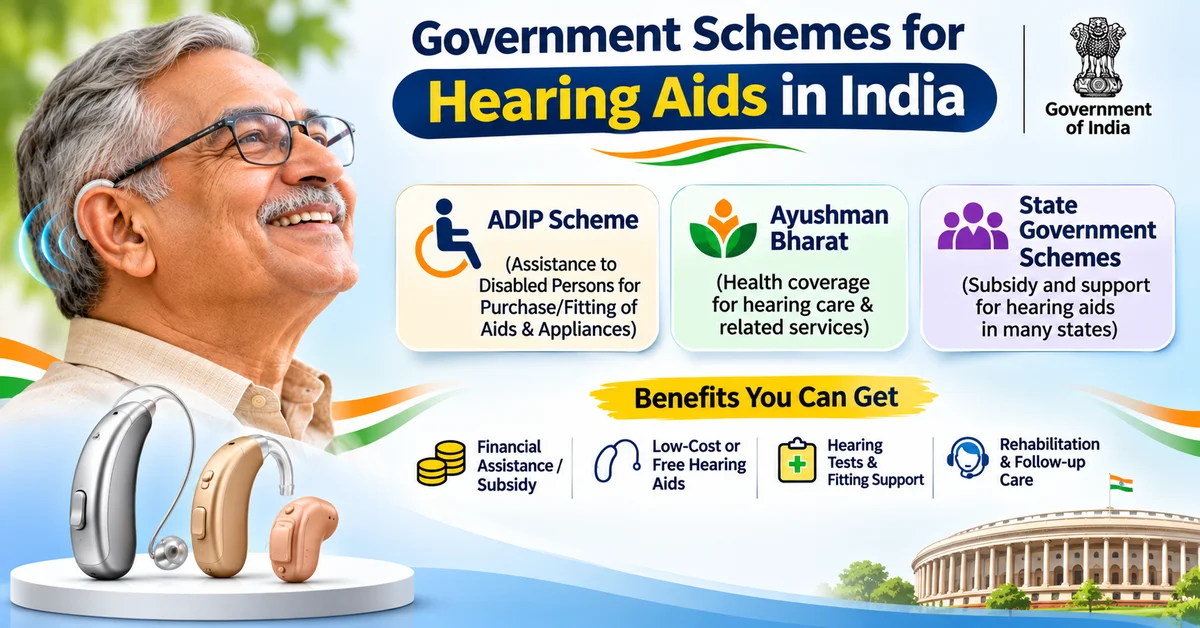
ADIP Scheme: free or 50% subsidised hearing aids for persons with 40% or more disability, within income limits.
Rashtriya Vayoshri Yojana: free hearing aids for senior citizens from low-income families.
CGHS and CS(MA) Rules: reimbursement for central government employees and pensioners.
GST exemption: no GST on hearing aids.
Income-tax relief: a flat deduction for taxpayers with a certified disability.
1. ADIP Scheme: The Main Government Scheme for Hearing Aids
The Assistance to Disabled Persons for Purchase/Fitting of Aids and Appliances scheme, known as ADIP, is run by the Department of Empowerment of Persons with Disabilities under the Ministry of Social Justice and Empowerment. It has operated since 1981 and was last revised with effect from April 2022. For most people with hearing loss, it is the first scheme to check.
Who Is Eligible for ADIP?
You are an Indian citizen of any age.
You hold a disability certificate showing at least 40% disability.
Your monthly income from all sources is within ₹30,000. For dependants, the income of parents or guardians counts.
You have not received the same kind of aid from any source in the last three years (one year for children under 12).
How Much Support Can You Get?
Income up to ₹22,500 per month: the government covers the full cost.
Income from ₹22,501 to ₹30,000 per month: the government covers 50% of the cost.
Device price: aids costing up to ₹15,000 qualify for full assistance in the first income band, items between ₹15,001 and ₹30,000 receive up to ₹15,000, and costlier items receive a 50% central share subject to approval.
Cochlear Implant Support for Children
Children with severe to profound hearing loss who do not benefit from hearing aids can receive support for a cochlear implant. The ceiling is ₹7 lakh for pre-lingual hearing loss (ages 1 to 5) and ₹6 lakh for acquired hearing loss (ages 5 to 18). This covers the implant, surgery, therapy, mapping, travel and pre-implant assessment. The Ali Yavar Jung National Institute of Speech and Hearing Disabilities (Divyangjan) in Mumbai is the nodal agency.
ADIP devices are issued through implementing agencies such as ALIMCO, national institutes and NGOs, often at assessment and distribution camps where hearing is tested and the device is fitted. The scheme's approval was tied to the Finance Commission cycle that ended in March 2026, and the Union Budget 2026-27 continued its funding, so confirm current limits on the official ADIP portal before you apply.
2. Rashtriya Vayoshri Yojana: Free Hearing Aids for Senior Citizens
Rashtriya Vayoshri Yojana (RVY) is a fully centrally funded scheme that provides physical aids and assisted-living devices to senior citizens with age-related disabilities. Hearing aids are on the list, along with walking sticks, wheelchairs, spectacles and artificial dentures.
Applicants must be 60 or above, hold an Aadhaar card, and belong to a Below Poverty Line family or have a monthly income of ₹15,000 or less. A medical officer must certify the hearing impairment. Devices are distributed in camp mode by ALIMCO in selected districts, so watch for notices from your district administration or social welfare office. RVY now sits under the wider Atal Vayo Abhyuday Yojana for senior citizens.
3. CGHS and Medical Reimbursement for Government Employees
Central government employees, pensioners and eligible dependants covered by CGHS or the Central Services (Medical Attendance) Rules can claim reimbursement for hearing aids. The usual process works like this:
A CGHS or government ENT specialist examines you and recommends the type of hearing aid, supported by an audiogram.
You obtain written permission before you buy.
You purchase the device and submit the claim with the bill, CGHS card, permission letter and the empty box showing the label.
Reimbursement is limited to the ceiling rate for your device type or the actual cost, whichever is lower. Replacement is usually allowed only after five years, and batteries and repairs are your responsibility. Ceiling rates are revised through office memoranda, so check the latest one. State government employees and others covered by departmental medical schemes should confirm their own rules, as these differ.
4. GST Exemption on Hearing Aids
Hearing aids and the parts used to make them are exempt from GST under the September 2025 Central Tax (Rate) notification, and the Finance Ministry reconfirmed this in Parliament in July 2026. In practical terms, the price you pay for a hearing instrument carries no GST. Repair and servicing are treated as services and may be taxed separately, so ask for an itemised bill.
5. Income-Tax Relief for Persons with Disability
A tax deduction is not a purchase subsidy, but it can offset the expense of living with hearing loss. Section 80U allows a taxpayer with a certified disability of 40% or more to claim a flat deduction of ₹75,000, or ₹1,25,000 for severe disability of 80% or more. Section 80DD offers a similar deduction to those who support a dependant with disability.
Both are available only if you opt for the old tax regime. The Income-tax Act, 2025, effective from 1 April 2026, carries these benefits forward under new section numbers, so check with a chartered accountant before you file.
6. School Programmes and State Schemes
Children with hearing loss may receive assistive devices through the inclusive education component of Samagra Shiksha, so ask your school's special educator or the block resource centre. The National Programme for Prevention and Control of Deafness supports screening and referral at government health facilities, and some facilities provide aids to eligible patients.
Many states also run their own programmes, such as cochlear implant support for children, disability pensions and device distribution camps. Your District Disability Rehabilitation Centre or district social welfare office can tell you what is active locally.
Documents You Will Usually Need
Disability certificate or UDID card
Aadhaar card
Income certificate (or BPL proof for RVY)
Passport-size photographs
Audiogram and ENT report
Proof of residence
How to Apply for a Government Hearing Aid
Get your hearing tested. Visit a government hospital or authorised audiology centre for an audiogram.
Obtain your disability certificate and UDID. The certificate must come from an authorised medical authority.
Register. Apply on the ADIP MIS portal or through ServicesPlus, or contact an implementing agency or your District Disability Rehabilitation Centre.
Submit your documents. Upload them and keep copies.
Attend the assessment camp. Your hearing is checked, eligibility is verified and the aid is fitted or scheduled.
Follow up. Return for fitting adjustments and servicing.
Waiting times vary by district and camp schedule, so start early.
What If You Do Not Qualify, or Cannot Wait?
Government-supplied devices are often basic models, and camps follow fixed schedules. If your income is above the limit, the wait is too long, or you want features such as rechargeable batteries, Bluetooth streaming or advanced noise management, buying privately may be more practical.
EarMart can help you compare hearing instruments across styles, technology levels and budgets, so you can match a device to your hearing loss, lifestyle and wallet. Since hearing aids carry no GST, you are not paying tax on the device itself. Whichever route you choose, begin with a proper hearing test and professional fitting, because even the best device performs poorly if it is not programmed to your audiogram.
Conclusion
Government support for hearing aids in India is real, but it works best when you know which door to knock on. ADIP covers eligible persons with disabilities, Rashtriya Vayoshri Yojana helps low-income seniors, CGHS reimburses government employees, and the GST exemption and tax deduction reduce costs for everyone else. Check your eligibility, gather your documents and apply early. If a scheme does not fit your situation, EarMart can help you find a hearing instrument that does.
Frequently Asked Questions (FAQs)
Does the Indian government give free hearing aids?
Yes. Under ADIP, eligible persons with 40% or more disability and a monthly income up to ₹22,500 can receive hearing aids free of cost. Low-income senior citizens can also get them through Rashtriya Vayoshri Yojana.
What is the income limit for ADIP hearing aids?
The limit is ₹22,500 per month for full cost coverage and up to ₹30,000 per month for 50% coverage. For dependants, the income of parents or guardians is considered.
Can senior citizens get free hearing aids?
Yes. Senior citizens aged 60 or above who are BPL or have a monthly income of ₹15,000 or less can apply under Rashtriya Vayoshri Yojana, with medical certification of hearing impairment. Those with a 40% disability certificate may also qualify under ADIP.
Is GST charged on hearing aids?
No. Hearing aids and their parts are exempt from GST. Repair and servicing services may be taxed separately.
Does ADIP cover cochlear implants?
Yes, for children. Support goes up to ₹7 lakh for pre-lingual hearing loss (ages 1 to 5) and ₹6 lakh for acquired hearing loss (ages 5 to 18).
How do I apply for a hearing aid under ADIP?
Register on the ADIP MIS portal or through ServicesPlus, upload your disability certificate, Aadhaar, income proof and photograph, then attend the assessment camp arranged by the implementing agency.
Can I claim hearing aid costs under CGHS?
Yes, if you are a CGHS or CS(MA) beneficiary. You need an ENT specialist's recommendation and prior permission, and reimbursement is capped at the ceiling rate or the actual cost, whichever is lower.