Free Hearing Test for Senior Citizens
Book a free hearing test for senior citizens with EarMart. Spot hearing loss early, get expert guidance and find the right solution for clearer hearing.
Book a Free Consultation
We'll call you within 24 hours. Your details are safe with us.
Free Hearing Test for Senior Citizens: Why It Matters and How to Get One
Do you often ask your parents or grandparents to repeat themselves? Does your loved one turn the television volume up higher every month? These small moments are easy to dismiss as part of getting older, but they can be early signs of hearing loss. The good news is that a free hearing test for senior citizens is a simple, painless and quick way to find out where things stand.
At EarMart, we believe every senior deserves clear, comfortable hearing without worry about cost or complicated procedures. This guide explains why hearing tests matter after 60, what to expect during one, and what to do with the results.
Why Hearing Tests Matter After 60
Hearing changes slowly, so most people do not notice the decline. The brain adapts, and families often adjust their habits without realizing it. Age-related hearing loss, known as presbycusis, is one of the most common health conditions among older adults. It usually affects both ears and tends to start with high-pitched sounds such as birdsong, doorbells and children’s voices.
Untreated hearing loss can affect much more than conversation. Research has linked it to:
Social withdrawal and loneliness
Reduced confidence in public places
Increased risk of falls due to poor awareness of surroundings
Faster cognitive decline in some studies
Stress, irritability and low mood
Missed safety signals such as alarms, horns and phone calls
Early detection changes the picture. When hearing loss is found early, it is easier to manage, and seniors adapt more quickly to support devices. A free hearing test removes the cost barrier and gives families a clear starting point.
Signs Senior Citizens Should Not Ignore
You do not need to wait for a serious problem before getting tested. If you or a loved one notices any of the following, it is time to book a check-up:
Frequently asking people to repeat themselves
Difficulty following conversations in noisy places such as markets, weddings or restaurants
Turning the TV or radio volume up higher than others prefer
Feeling that people mumble when they speak
Trouble hearing on the phone
Ringing, buzzing or hissing sounds in the ears (tinnitus)
Missing the doorbell, alarms or knocks on the door
Feeling tired after long conversations because of the effort to listen
Avoiding gatherings because following the conversation is stressful
Even one or two of these signs are reason enough to get tested. Many seniors say they simply felt relieved to finally have answers.
What Is Included in a Free Hearing Test?
A hearing screening is non-invasive and comfortable. There are no injections, no needles and no discomfort. A typical free hearing test for seniors includes the following steps.
1. A Short Conversation About Your Hearing
The hearing specialist begins by asking about your daily life. Do you struggle on phone calls? Is it harder to hear in groups? Have you been exposed to loud noise during work? Do you take any regular medicines? These details help interpret the results correctly.
2. A Visual Check of the Ear
A quick look into the ear canal helps identify problems such as excess earwax, which can cause temporary hearing difficulty and is sometimes mistaken for permanent loss.
3. Pure Tone Audiometry
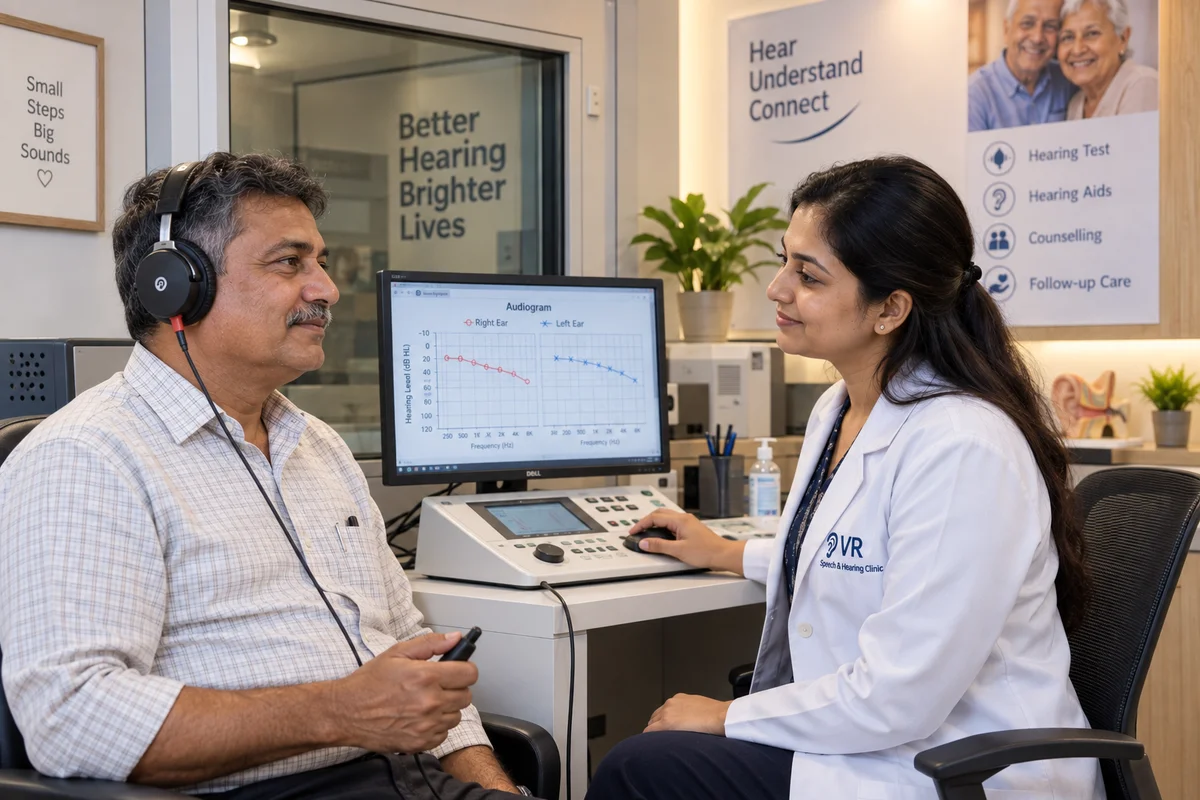
You wear headphones and listen to a series of soft beeps at different pitches. Whenever you hear a sound, you press a button or raise your hand. This shows the softest sounds you can hear across low, medium and high frequencies.
4. Speech Understanding Check
Hearing a sound and understanding words are different things. Speech testing checks how clearly you can follow spoken words, which is often the real challenge for seniors in daily conversation.
5. Results Explained in Simple Language
At the end, the specialist walks you through your results, explains what they mean and answers your questions. There is no pressure and no complicated jargon.
How Long Does a Hearing Test Take?
Most hearing screenings take around 20 to 30 minutes. The test is relaxed and unhurried, so seniors can take their time. Family members are welcome to accompany you, and in fact it helps to bring someone along who can share what they have noticed.
Understanding Your Hearing Test Results
After the test, your results are usually presented on a chart called an audiogram. In simple terms, hearing is generally described in these categories:
Normal hearing: You can hear soft sounds across all pitches.
Mild hearing loss: Soft speech and background conversations are hard to follow.
Moderate hearing loss: Normal conversation becomes difficult without effort.
Severe or profound hearing loss: Many everyday sounds are missed, and louder speech may still be unclear.
Hearing loss is also described by type. Sensorineural loss involves the inner ear or hearing nerve and is the most common type in older adults. Conductive loss involves a blockage or issue in the outer or middle ear, such as wax buildup or fluid. Some people have a mix of both. If a test suggests a medical issue, you will be advised to consult an ENT doctor.
What Happens After the Test?
The result of a hearing test is not always a hearing aid. Depending on your outcome, the recommendation may be:
No action needed: Your hearing is healthy, and a follow-up test in a year is a good habit.
Monitoring: Mild changes may simply be tracked over time.
Medical referral: If an infection, blockage or other condition is suspected, you will be guided to a doctor.
Hearing solutions: If hearing loss is confirmed, you can explore modern hearing aids suited to your lifestyle and budget.
Modern Hearing Aids for Seniors
Today’s hearing devices are very different from the bulky ones many people remember. They are small, comfortable and discreet, and many are designed with seniors in mind. Common options include:
Behind-the-ear (BTE) aids: Sturdy, powerful and easy to handle.
In-the-ear (ITE) aids: Fit inside the ear and are easy to wear.
Receiver-in-canal (RIC) aids: Slim, discreet and popular for clear sound.
Rechargeable models: No small batteries to replace, which is helpful for those with limited finger dexterity.
A good hearing specialist will recommend a device based on your hearing level, lifestyle, comfort and budget, never just the most expensive option.
How to Prepare for Your Free Hearing Test
A little preparation makes the visit smoother:
Carry a list of any medicines you take regularly.
Note the situations where you struggle most to hear.
Bring a family member or friend for support.
Avoid exposure to very loud noise on the day of the test.
Come with your questions written down so nothing is forgotten.
Simple Habits to Protect Your Hearing
While age-related changes cannot be fully prevented, these habits help protect the hearing you have:
Keep the volume on headphones and televisions at a safe level.
Avoid inserting cotton buds or sharp objects into the ear.
Stay active, since good circulation supports ear health.
Manage blood pressure and diabetes, which can affect hearing.
Get a hearing check-up at least once a year after 60.
Seek help early rather than waiting for hearing to worsen.
Why Choose EarMart for Your Hearing Check-Up?
Seniors need patience, clarity and respect, and that is how EarMart approaches every visit. Our focus is on honest guidance and a comfortable experience from start to finish. You will not be rushed, and you will never be pushed into a purchase. Whether you simply want peace of mind or need support with a hearing solution, our team is here to explain your options in a way that makes sense.