Hearing Aids in City Centre Book Consultation Today
Looking for hearing aids in city centre Aurangabad? EarMart offers free hearing tests, trusted brands, expert fitting and aftercare. Hear clearly again today.
Book a Free Consultation
We'll call you back. Your details are safe with us.
Hearing Aids in City Centre Aurangabad: A Complete Guide by EarMart
Losing your hearing does not happen overnight. It creeps in slowly. You ask people to repeat themselves, turn the television up a little louder, or avoid family gatherings because conversations feel exhausting. If this sounds familiar, you are not alone, and help is closer than you think.
If you are searching for hearing aids in city centre Aurangabad, this guide explains what to look for, how modern hearing aids work, and why more families trust EarMart for their hearing care.
Understanding Hearing Loss in Aurangabad
Hearing loss affects millions of people across India, and it is not limited to the elderly. Busy traffic, noisy workplaces, long hours with earphones, untreated ear infections and ageing all contribute. In a growing city like Aurangabad, now also known as Chhatrapati Sambhajinagar, more people are becoming aware of the need for professional hearing care.
Common signs of hearing loss include:
Difficulty following conversations in crowded places
Frequently asking people to repeat themselves
Hearing speech but struggling to understand words
Turning up the volume on the TV or phone
Ringing or buzzing in the ears (tinnitus)
Trouble hearing on the phone
Feeling tired after long conversations
If you notice two or more of these signs, a hearing test is the best next step. Early action gives better results and helps your brain stay used to processing sound.
Why Choose a Hearing Aid Clinic in the City Centre?
Convenience matters when you are choosing a hearing partner. Hearing aids are not a one-time purchase. They need fitting, fine-tuning, cleaning, and regular check-ups. A clinic in the city centre makes all of this easier.
Easy access: Central locations are reachable by auto, bus and car from most parts of the city, which is helpful for senior citizens who may need a family member to accompany them.
Quick follow-ups: Your first few weeks with a hearing aid involve adjustments. A nearby clinic means you can walk in for small fixes without losing a day of travel.
Trusted local support: When your hearing aid needs repair or servicing, you want a team that is nearby and responsive.
About EarMart
EarMart is a hearing care provider focused on making better hearing simple, affordable and accessible. The goal is to give every customer honest advice, a proper hearing evaluation and a device that suits their lifestyle and budget, rather than pushing a one-size-fits-all product.
What customers can expect at EarMart:
A comfortable, professional hearing assessment
Personalised recommendations based on the type and degree of hearing loss
A choice of hearing aid styles and technology levels
Careful fitting and programming
Clear guidance on usage, cleaning and maintenance
Ongoing aftercare and follow-up support
Types of Hearing Aids Available
Choosing the right style depends on your hearing level, ear shape, dexterity, lifestyle and budget. Here are the most common options.
Behind-the-Ear (BTE) Hearing Aids
These sit behind the ear and connect to a custom earmould or tube. They are powerful, durable and easy to handle, which makes them a popular choice for moderate to severe hearing loss and for senior users.
Receiver-in-Canal (RIC) Hearing Aids
Small and discreet, RIC models place the speaker inside the ear canal while the main body rests behind the ear. They offer natural sound quality and are suitable for mild to moderately severe hearing loss.
In-the-Ear (ITE) Hearing Aids
Custom-made to fit the outer ear, these are easy to insert and remove. They suit mild to moderate hearing loss.
In-the-Canal (ITC) and Completely-in-Canal (CIC) Hearing Aids
These are nearly invisible and sit deep within the ear canal. They are ideal for people who want a discreet device, though smaller size can mean shorter battery life and less room for extra features.
Rechargeable Hearing Aids
Rechargeable models remove the hassle of changing tiny batteries. Charge overnight and wear all day. They are especially convenient for people with limited finger dexterity.
Features of Modern Digital Hearing Aids
Today’s hearing aids are far more advanced than the whistling, bulky devices many people remember. Modern digital hearing aids offer:
Noise reduction that softens background sound so speech stands out
Directional microphones that focus on the person speaking in front of you
Feedback suppression to prevent whistling
Bluetooth connectivity for calls and music on compatible phones
Multiple listening programs for quiet rooms, restaurants, outdoors and more
Tinnitus support in selected models
Water and dust resistance for everyday durability
Higher-level devices adapt automatically to your surroundings, while basic models offer reliable amplification at a lower cost. The right choice is the one that matches your daily life, not necessarily the most expensive one.
What Happens During a Hearing Test?
Many people delay a hearing test because they are unsure what to expect. It is simple, painless and usually takes under an hour.
Conversation and history: You discuss your symptoms, lifestyle and any ear problems.
Ear examination: The ears are checked for wax or visible blockages.
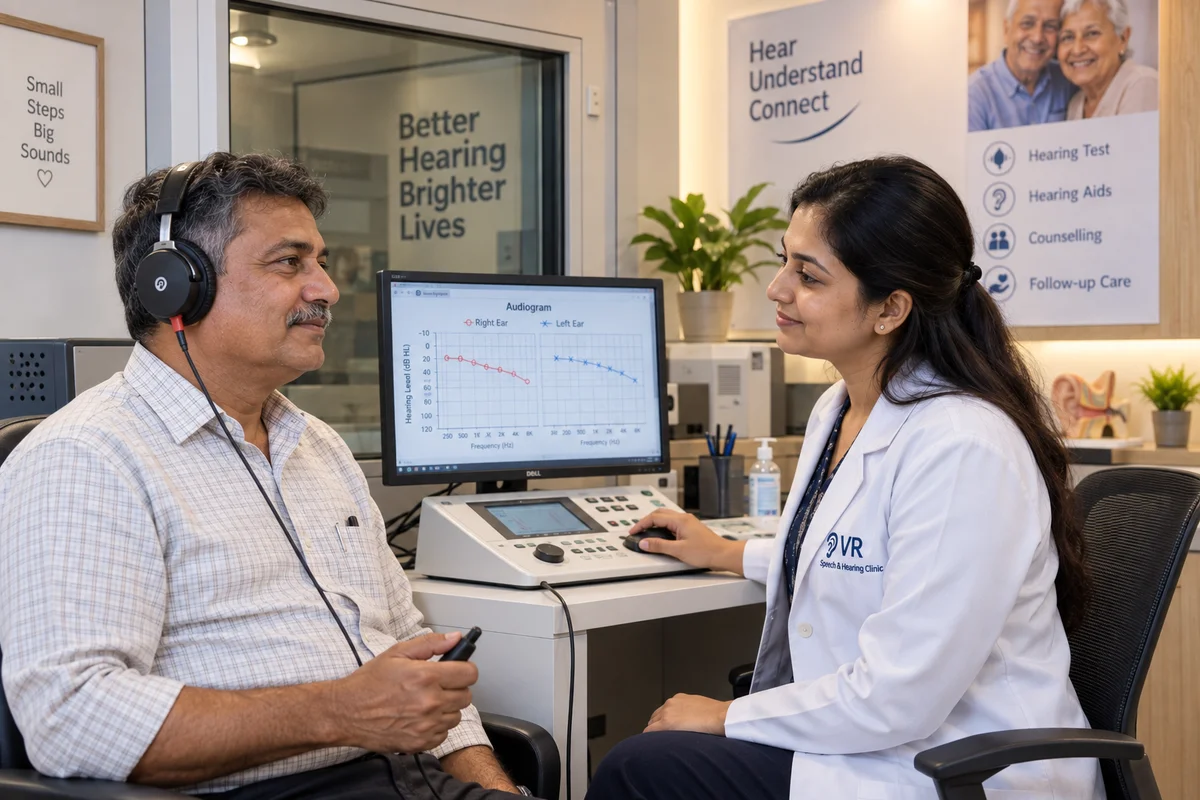
Pure tone audiometry: You listen to a series of beeps at different pitches and indicate when you hear them.
Speech testing: This checks how clearly you understand spoken words.
Results and advice: Your hearing profile is explained in plain language, and options are discussed.
If the test suggests a medical issue, you will be advised to consult an ENT specialist before proceeding with a hearing aid.
How to Choose the Right Hearing Aid
Keep these points in mind when comparing options.
Know your hearing level. A proper test is the foundation of a good choice. Never buy a hearing aid without one.
Consider your lifestyle. If you spend time in meetings, restaurants or social events, you will benefit from stronger noise management. If your days are quiet and mostly at home, simpler technology may be enough.
Think about comfort and appearance. A hearing aid you are comfortable wearing is one you will actually use every day.
Set a realistic budget. Prices vary widely depending on technology level and features. A good provider will explain the differences and help you find the best value rather than the highest price.
Check aftercare. Warranty, servicing, cleaning and adjustments are as important as the device itself.
Avoid cheap amplifiers. Low-cost sound amplifiers sold without testing are not the same as programmable hearing aids. They amplify everything equally, including noise, and may not protect your remaining hearing.
Tips for Getting Used to Your New Hearing Aid
Adjusting takes time because your brain needs to relearn sounds it has been missing. Be patient and follow these tips:
Start by wearing the device for a few hours each day, then increase gradually
Begin in quiet spaces before moving to noisy places
Practise conversations with family at home
Keep the device clean and dry
Store it safely overnight
Attend all follow-up appointments for fine-tuning
Most users notice a big difference in confidence and communication within a few weeks.
Why Treating Hearing Loss Early Matters
Untreated hearing loss does more than make conversation difficult. Research has linked it with social withdrawal, loneliness, reduced concentration and, over time, a higher risk of cognitive decline. Using hearing aids helps you stay connected with family, remain active at work, and enjoy everyday sounds like birdsong, music and your grandchildren’s voices.
Visit EarMart for Hearing Aids in City Centre Aurangabad
If you or a loved one has been struggling to hear, do not wait for it to get worse. A short hearing assessment can give you clarity and a clear plan. At EarMart, the focus is on honest guidance, quality devices and support that continues long after your first visit.
Better hearing is closer than you think. Book your hearing test with EarMart today and take the first step toward clearer conversations and a more connected life.
Frequently Asked Questions (FAQs)
1. Where can I find hearing aids in city centre Aurangabad?
EarMart provides hearing tests, hearing aid fitting and aftercare for customers in and around the city centre of Aurangabad (Chhatrapati Sambhajinagar).
2. How much do hearing aids cost in Aurangabad?
Prices depend on the style, technology level and brand. Basic digital models are more affordable, while advanced rechargeable and Bluetooth-enabled models cost more. A hearing test helps determine what you actually need.
3. Is a hearing test necessary before buying a hearing aid?
Yes. A hearing test shows the type and degree of your hearing loss, so the device can be programmed correctly for you.
4. Which hearing aid is best for senior citizens?
Behind-the-ear and rechargeable models are often preferred because they are easy to handle, comfortable and powerful. The best choice depends on individual hearing levels.
5. Can hearing aids restore normal hearing?
Hearing aids do not cure hearing loss, but they greatly improve your ability to hear and understand speech and everyday sounds.
6. How long do hearing aids last?
With proper care, most hearing aids last around four to six years or more. Regular cleaning and servicing extend their life.
7. Are invisible hearing aids suitable for everyone?
Not always. Very small devices suit mild to moderate hearing loss and certain ear shapes. Your hearing specialist will advise whether they are right for you.
8. How long does it take to get used to hearing aids?
Most people adapt within a few weeks, though full comfort can take a couple of months. Wearing them consistently helps.
9. Do hearing aids work in noisy places?
Modern digital hearing aids include noise reduction and directional microphones that improve speech clarity in noisy environments, though no device removes background noise completely.
10. How often should I get my hearing checked?
Adults over 50 should get tested yearly, and anyone who notices hearing difficulty should get tested promptly.