ITE Hearing Aids Types, Benefits & Buying Guide
Get expert guidance from certified specialists. Fill in the form and our team will call you back within 24 hours — completely free, no obligation.
Book a Free Consultation
We'll call you within 24 hours. Your details are safe with us.
ITE Hearing Aids: The Complete Guide to In-the-Ear Hearing Devices
If you have noticed that conversations sound muffled, the TV volume keeps going up, or you often ask people to repeat themselves, a hearing aid may help. Among the many styles available today, ITE hearing aids are one of the most popular choices for adults who want a comfortable, custom-fitted and discreet device. This guide from EarMart explains what ITE hearing aids are, how they work, who they suit, their pros and cons, and what to check before you buy.
What Are ITE Hearing Aids?
ITE stands for “in-the-ear”. An ITE hearing aid is a custom-made device that sits inside the outer part of your ear, filling the bowl-shaped area called the concha. Unlike behind-the-ear (BTE) models, where the electronics sit behind the ear and connect to the ear canal through a tube or wire, everything in an ITE aid is built into a single shell moulded to the shape of your ear.
In simple Marathi-English terms: ITE म्हणजे कानाच्या आत बसणारे श्रवणयंत्र. यात मायक्रोफोन, अॅम्प्लिफायर, स्पीकर आणि बॅटरी एकाच छोट्या शेलमध्ये असतात, आणि ते तुमच्या कानाच्या मापानुसार बनवले जाते.
How Do ITE Hearing Aids Work?
Every hearing aid has the same core parts, and ITE models pack them into a compact shell:
The microphone picks up sound from your surroundings and converts it into an electrical signal.
The processor (the digital chip) analyses the signal, amplifies the frequencies you struggle with, and reduces unwanted background noise based on your hearing test results.
The receiver (speaker) sends the amplified sound into your ear canal.
The battery powers the device. Many ITE models use small disposable zinc-air batteries, while some newer ones offer rechargeable options.
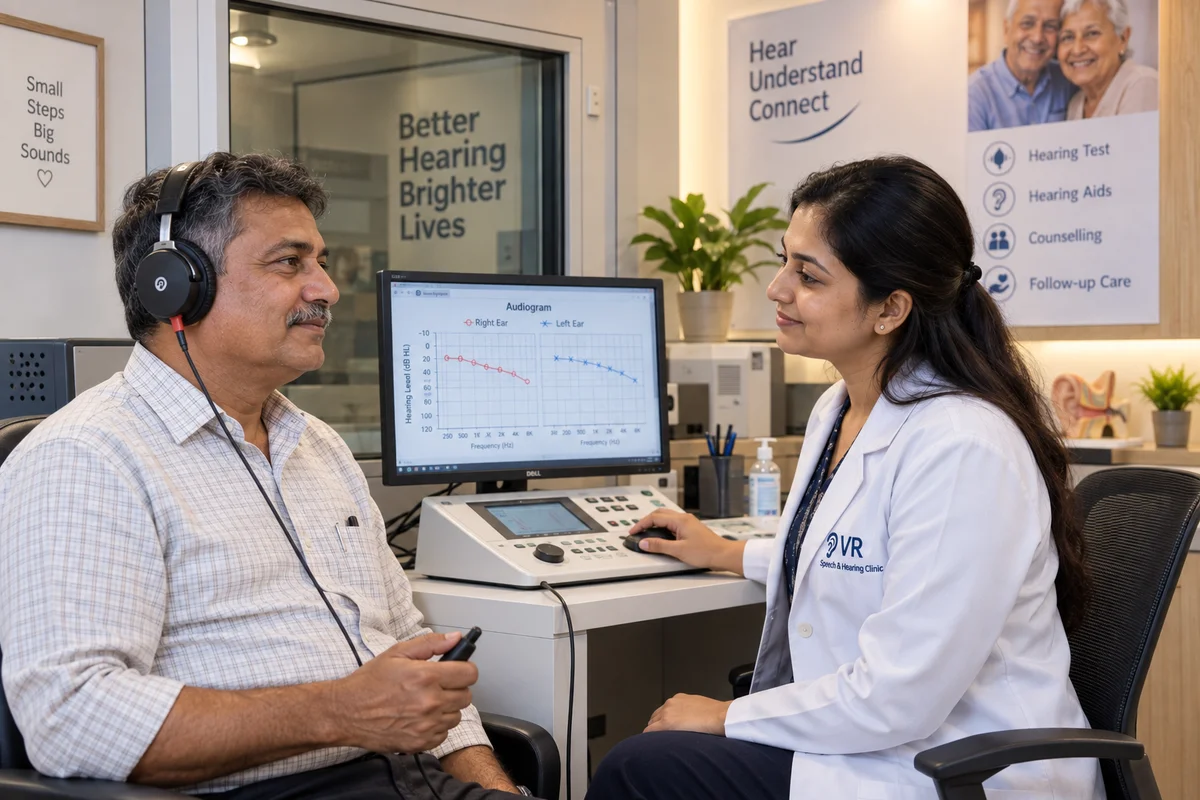
Your audiologist programmes the device using your audiogram, so the amplification matches your exact hearing loss pattern rather than simply making everything louder.
Types of ITE Hearing Aids
“ITE” is often used as an umbrella term. The main custom styles differ by size and how deep they sit in the ear.
Full-shell ITE: The largest style, filling most of the outer ear bowl. It has room for bigger batteries, directional microphones and extra controls, and it suits mild to severe hearing loss.
Half-shell ITE: Smaller than the full shell, filling roughly half of the bowl. It suits mild to moderately severe hearing loss and offers a good balance of size and features.
ITC (in-the-canal): Sits partly in the ear canal and is less visible than a half shell. It suits mild to moderate hearing loss.
CIC (completely-in-canal): Sits deeper in the canal and is hard to notice from the outside. It suits mild to moderate loss, but its small size limits manual controls and battery life.
IIC (invisible-in-canal): The smallest custom option, placed very deep in the canal. It is nearly invisible but needs suitable ear anatomy and good dexterity to handle.
Key Benefits of ITE Hearing Aids
Discreet appearance
Because the device sits inside the ear, it is much less noticeable than many BTE models. Smaller styles like CIC and IIC are almost hidden, which appeals to people who feel self-conscious about wearing a hearing aid.Custom fit and comfort
An ITE aid is built from an impression or scan of your ear, so it sits securely. A good fit reduces whistling (feedback) and improves sound quality.Natural sound quality
Placing the microphone near the ear canal opening lets the device use your ear’s natural sound-collecting shape. Many users find voices and everyday sounds more natural.Easy to use with phones
Since nothing sits behind the ear, ITE aids are generally comfortable alongside spectacles, masks and headphones. Holding a phone to your ear is also easier.Less wind noise (in some styles)
Smaller in-canal models sit sheltered inside the ear, so they tend to pick up less wind noise than devices sitting behind the ear.Useful features in larger shells
Full-shell and half-shell models often have room for directional microphones, volume controls, program buttons and sometimes wireless connectivity.
Limitations of ITE Hearing Aids
An honest buying decision needs both sides.
Not ideal for severe or profound loss: Very small devices cannot always deliver the power needed for severe hearing loss. BTE or power models may suit better.
Earwax and moisture: Because the device sits in the ear, wax and sweat can block the microphone or speaker. This matters in humid or hot weather, so regular cleaning is essential.
Smaller batteries and controls: Compact models use tiny batteries that need frequent replacement, and small buttons can be hard for people with limited finger dexterity.
Occlusion effect: Some wearers feel their own voice sounds “boomy” or blocked. A properly vented, well-fitted device usually reduces this.
Not suitable for every ear: Very narrow ear canals, frequent ear infections or certain ear conditions may make an in-ear device unsuitable. An examination by an ENT doctor or audiologist is important.
Growing ears: Children’s ears grow quickly, so custom ITE devices are not usually the first choice for young children.
Who Should Consider ITE Hearing Aids?
ITE hearing aids are commonly considered by:
Adults with mild to moderately severe hearing loss.
People who want a less visible hearing solution.
Users who wear glasses, masks or helmets often and find behind-the-ear devices awkward.
People comfortable handling small devices and doing simple daily cleaning.
If you are unsure, the right step is a professional hearing test. Style should always follow your audiogram, ear shape and lifestyle, not just appearance.
ITE vs BTE Hearing Aids
BTE devices are larger, more powerful and easier to handle, and they work for almost every degree of hearing loss, including severe and profound. ITE devices are more discreet and custom-fitted but have size limits on power, battery life and features.
Choose ITE if discretion, comfort with glasses and natural sound matter most and your loss is mild to moderately severe. Choose BTE if you have severe hearing loss, frequent ear problems, or find small devices difficult to handle. A qualified audiologist can compare both on your own hearing profile.
ITE Hearing Aid Price in India: What Affects the Cost?
Prices vary widely, so be careful with any single “standard” figure. The main factors are:
Technology level: Basic, mid-range and premium processors differ in noise handling, speech clarity and automatic adjustment.
Brand and model: Well-known manufacturers offer different ranges at different price points.
Style: Custom shells made to order can cost differently from standard off-the-shelf devices.
Features: Rechargeability, Bluetooth, tinnitus support and directional microphones add to cost.
Fitting and after-sales care: Professional fitting, adjustments, servicing and warranty form a real part of the value. A hearing aid that is poorly programmed will not perform well, whatever its price.
Many buyers ask about trial periods, EMI options and home fitting support before finalising, so it is worth asking about these upfront.
How to Choose the Right ITE Hearing Aid
Get a proper hearing assessment first
A pure-tone audiogram and speech test tell you the type and degree of your hearing loss. Never buy a hearing aid without one.Rule out medical causes
Wax blockage, infection or fluid can cause temporary hearing loss. Get your ears examined before deciding.Match style to hearing loss
Smaller devices suit milder loss. If your loss is greater, a full-shell or BTE may be more effective.Think about your daily life
Do you work in noisy places, attend meetings, use a phone often or spend time outdoors? Your lifestyle should guide the feature choice.Ask about a trial period
Wearing the device in real situations, at home, in the market and in conversation, is the best way to judge it.Check service and warranty
Ask about adjustments, repairs, loaner devices and warranty terms before you buy.
How to Care for Your ITE Hearing Aid
Wipe the device daily with a soft dry cloth and clean the microphone and receiver openings with the supplied brush or tool.
Remove the device before bathing, swimming or using a hair dryer, and keep it away from water.
Store it in a dry case overnight, and open the battery door so air can circulate.
During monsoon, use a dehumidifier or drying kit, since moisture is a common cause of faults.
Visit your audiologist regularly for cleaning and fine-tuning, usually every few months.
When Should You Get Your Hearing Checked?
See an audiologist if you struggle to follow conversations in groups, often ask people to repeat themselves, find phone calls difficult, hear ringing in your ears, or if family members say you play the TV too loudly. Sudden hearing loss in one or both ears is a medical emergency, so consult a doctor immediately. Early action leads to better results, because the brain adapts more easily to sound when hearing loss is addressed sooner.
Final Thoughts
ITE hearing aids offer a good mix of comfort, discretion and natural sound for people with mild to moderately severe hearing loss. They are not the right answer for everyone, and the best style depends on your audiogram, ear anatomy, lifestyle and budget. With a proper hearing test, expert fitting and regular care, an ITE hearing aid can make conversations, family time and work much easier.
At EarMart, our goal is to help you understand hearing health clearly so that you can make a confident, informed choice. If you suspect hearing loss, book a hearing assessment with a qualified audiologist and start your journey toward better hearing.