What Level of Hearing Loss Requires a Hearing Aid?
What Level of Hearing Loss Requires a Hearing Aid?
If you keep asking people to repeat themselves, turning the TV up, or avoiding noisy restaurants, you may be wondering where “normal” ends and “needs help” begins. So, what level of hearing loss requires a hearing aid?
Most audiologists recommend hearing aids when hearing loss reaches the mild-to-moderate range, roughly 26 to 40 decibels (dB HL) or worse, particularly when it affects daily communication. But the number on your hearing test is only part of the story. This guide explains the levels of hearing loss, what each one means in real life, and how to know when it’s time to act.

How Hearing Loss Is Measured
Hearing is measured with a hearing test called an audiogram. During the test, you listen to tones at different pitches (frequencies) and volumes. The softest sound you can hear at each pitch is recorded in decibels hearing level (dB HL). The higher the number, the louder a sound must be before you can hear it, meaning your hearing loss is greater.
The audiogram looks at pitches from low (like a bass drum) to high (like birdsong or the consonants “s,” “f,” and “th”). Many people lose high-pitched hearing first, which is why speech can sound muffled or unclear even when it seems loud enough.
The Degrees of Hearing Loss
Audiologists commonly group results into these categories:
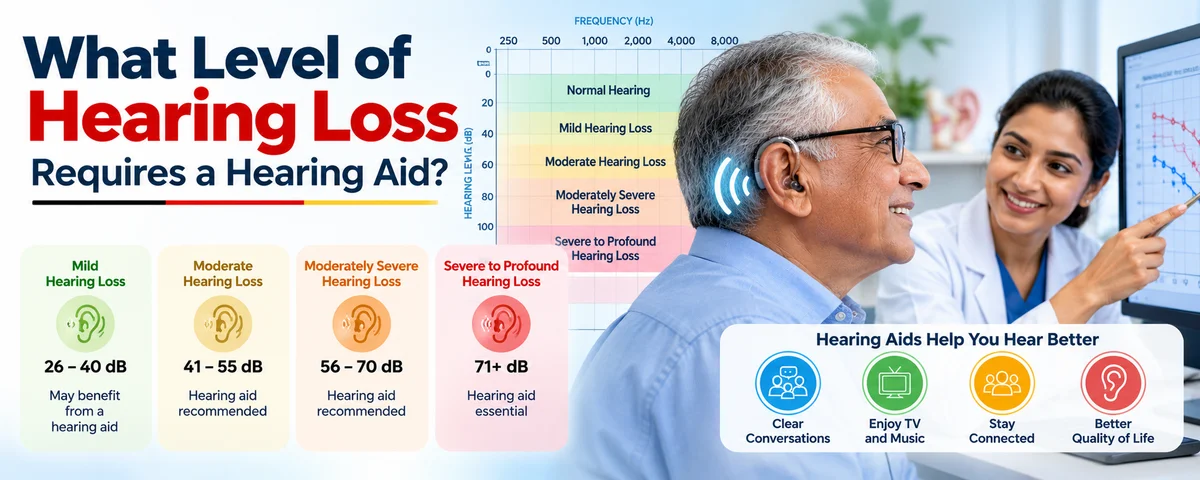
Normal hearing: up to about 25 dB HL
Mild hearing loss: 26 to 40 dB HL
Moderate hearing loss: 41 to 55 dB HL
Moderately severe hearing loss: 56 to 70 dB HL
Severe hearing loss: 71 to 90 dB HL
Profound hearing loss: 91 dB HL and above
Different organizations draw slightly different lines. Some classify 16 to 25 dB as “slight” loss, for example. That’s one reason your audiologist’s advice matters more than a single chart.
Which Level of Hearing Loss Needs a Hearing Aid?
Slight Hearing Loss (16–25 dB)
Hearing aids are not usually needed at this stage. You may notice occasional trouble in noisy places, but most conversations feel manageable. It’s still worth getting a baseline test, especially if you work around loud noise or have a family history of hearing loss.
Mild Hearing Loss (26–40 dB)
This is where hearing aids often start to become helpful. Soft sounds like whispers, rustling leaves, or distant speech may be missed. Group conversations, meetings, and restaurants become tiring. Many people with mild loss benefit from hearing aids, particularly if their job or social life depends on clear communication. Some choose to wait, but early treatment can help you stay engaged and adapt more easily.
Moderate Hearing Loss (41–55 dB)
At this level, hearing aids are generally recommended. Normal conversation can be hard to follow without help, and you may rely on lip reading, increased TV volume, or frequent repetition. Hearing aids make speech clearer and reduce listening fatigue.
Moderately Severe Hearing Loss (56–70 dB)
Hearing aids are strongly recommended. Without amplification, you may miss most of a normal conversation. Phone calls, group settings, and background noise become especially difficult.
Severe Hearing Loss (71–90 dB)
Powerful hearing aids are typically needed, and you may benefit from other assistive tools such as captioning or remote microphones. Without devices, most speech is inaudible.
Profound Hearing Loss (91 dB and above)
Standard hearing aids may provide limited benefit. Your audiologist may discuss cochlear implants or other advanced options, along with communication strategies.
It’s Not Just About the Numbers
Two people with the same audiogram can have very different experiences. Here is why a decibel number alone doesn’t decide whether you need hearing aids.
Speech understanding matters. Some people hear that someone is talking but cannot make out the words. Audiologists test word recognition in addition to tones, because clarity can be reduced even when volume seems adequate.
Your lifestyle counts. A teacher, a call center agent, or someone who attends many meetings may need hearing aids sooner than someone who lives quietly. Hearing needs depend on how much you rely on listening.
The pattern of loss counts. A loss that affects mainly high pitches (very common with age and noise exposure) can make speech unclear even if your average hearing looks only mild. Hearing aids are tuned to boost exactly those missing pitches.
One ear or both? Hearing loss in a single ear can make it hard to tell where sounds come from and to hear in noise. Treatment depends on the cause and severity.
Signs You May Need a Hearing Aid
You don’t need to wait for a formal diagnosis to suspect a problem. Consider a hearing test if you notice that you:
Ask people to repeat themselves often
Feel that people mumble
Struggle to follow conversations in restaurants or crowds
Turn up the TV or phone volume higher than others prefer
Have difficulty understanding women’s or children’s voices
Miss doorbells, alarms, or phone rings
Feel exhausted after social events from concentrating so hard
Avoid gatherings because listening is stressful
Hear ringing, buzzing, or humming in your ears (tinnitus)
If several of these sound familiar, a hearing evaluation is the best next step.
Why Early Treatment Matters
Many people wait years before getting help. Untreated hearing loss has been linked in research to social withdrawal, frustration, reduced job performance, and a higher risk of cognitive decline. Treating hearing loss earlier helps keep your brain accustomed to processing sound, and it’s usually easier to adjust to hearing aids when your loss is still mild or moderate.
Early support also protects relationships. Conversations stay more relaxed, and family members don’t have to repeat themselves or shout.
What Happens at a Hearing Test?
A hearing evaluation is quick and painless. It generally includes:
A conversation about your history, including noise exposure, medications, and symptoms
An ear examination to check for wax or blockages
Pure-tone testing to find your hearing thresholds
Speech testing to measure how well you understand words
A review of results, where your audiologist explains your audiogram and recommends next steps
If a medical cause is suspected, such as infection, fluid, or sudden hearing loss, you may be referred to an ear, nose, and throat (ENT) doctor. Sudden hearing loss is a medical emergency and should be evaluated immediately.
Types of Hearing Aids to Consider
Once you know your level of hearing loss, you can explore styles that match your needs:
Behind-the-ear (BTE): Durable and powerful, suitable for many hearing levels
Receiver-in-canal (RIC): Discreet, popular for mild to moderately severe loss
In-the-ear (ITE) and in-the-canal (ITC): Custom-fit options that sit within the ear
Completely-in-canal (CIC): Nearly invisible, best for mild to moderate loss
Rechargeable models: Convenient, with no tiny batteries to change
Bluetooth-enabled models: Stream calls and audio directly to your ears
The right choice depends on your hearing profile, ear shape, dexterity, budget, and daily routine. At EarMart, you can explore a range of hearing solutions suited to different levels of hearing loss, and compare features that matter most to you.
Over-the-Counter vs. Prescription Hearing Aids
In some countries, including the United States, over-the-counter hearing aids are available for adults who perceive mild to moderate hearing loss. They can be a good starting point if your difficulties are modest and you’re comfortable setting up the device yourself.
Prescription hearing aids, fitted by a professional, are better suited to moderate-to-profound loss, complex hearing patterns, or anyone who wants personalized programming and follow-up care. Rules and availability vary by country, so check what applies where you live.
Tips for Getting the Most From Hearing Aids
Give yourself time. Your brain needs weeks to adjust to hearing sounds again.
Wear them consistently. Daily use leads to faster adaptation.
Keep follow-up appointments. Fine-tuning improves comfort and clarity.
Clean them regularly. Wax and moisture are common causes of poor performance.
Practice in different settings. Start at home, then try quiet cafés and busier places.
Final Thoughts
So, what level of hearing loss requires a hearing aid? In general, hearing aids are recommended from mild-to-moderate hearing loss onward, especially when you struggle to follow conversations, and they become increasingly essential as hearing loss progresses. But your audiogram, speech understanding, and everyday challenges all matter. If you suspect hearing changes, don’t wait for them to become severe. Get tested, understand your results, and choose a solution that fits your life.
EarMart is here to help you take that first step toward clearer, more confident hearing.
FAQs
1. At what decibel level do you need a hearing aid?
Hearing aids are usually considered when hearing loss reaches about 26 to 40 dB HL or more and begins affecting communication. They are typically recommended for moderate loss (41 dB and above).
2. Can you wear a hearing aid for mild hearing loss?
Yes. Many people with mild hearing loss benefit from hearing aids, especially in noisy settings, meetings, or group conversations.
3. Do I need a hearing aid if I can hear but can’t understand words?
Possibly. Difficulty understanding speech, even when you can hear sound, is a common sign of hearing loss that hearing aids can help with. A hearing test with speech testing can confirm this.
4. Is it bad to wait to get a hearing aid?
Waiting can make adjustment harder and may contribute to social isolation and listening fatigue. Earlier treatment generally leads to easier adaptation.
5. Can hearing aids fix severe hearing loss?
Hearing aids can provide significant help for severe loss, though results vary. For profound loss, cochlear implants or other devices may be recommended.
6. How often should I get my hearing tested?
Adults should consider a baseline test by middle age and then every few years, or annually if you’re over 60 or notice changes.
7. Can I buy hearing aids without a prescription?
In some countries, over-the-counter hearing aids are available for adults with perceived mild to moderate loss. Regulations differ by location.
8. Do I need hearing aids in both ears?
Most people with hearing loss in both ears benefit from two hearing aids, which improve sound direction and understanding in noise.