What to expect during a professional hearing test
What to expect during a professional hearing test
A professional hearing test is a comprehensive, non-invasive clinical evaluation that measures how well your auditory system detects sound pitches and volume levels. The complete appointment typically takes 30 to 45 minutes, combining physical ear examinations with tone and speech checks. You receive an audiogram chart that maps your auditory thresholds, helping identify any changes in your hearing clarity.
This guide is published by HearMart, a dedicated hearing care provider offering diagnostic screenings and hearing aids across India.
Key takeaways
A clinical evaluation identifies the softest sounds you can detect across frequencies using specialized acoustic equipment.
The full testing process takes between 30 and 45 minutes, including the ear inspection, tone checks, and result discussion.
Results are mapped on an audiogram, where the normal hearing range in decibels is 0 to 25 decibels hearing level.
Testing separates conductive issues in the outer or middle ear from sensorineural changes in the inner ear pathway.
Periodic assessments help adults monitor auditory thresholds and take practical steps before communication difficulties escalate.
Recognizing common signs of hearing loss
Auditory changes typically develop slowly over several years, making early shifts difficult to spot immediately. Most individuals adapt to diminishing sound clarity by altering their daily habits, raising device volumes, or avoiding group gatherings entirely. Recognizing subtle signs of hearing loss allows you to seek clinical guidance early, protecting communication clarity, emotional wellness, and social participation across personal and work environments.

Photo: Samuel Wibisono
Daily conversation and communication changes
One of the earliest indicators of auditory decline appears during everyday verbal exchanges. You may notice that spoken words sound muffled rather than distinct, leading to the impression that family members, colleagues, or strangers are constantly mumbling. Following conversations requires deliberate concentration, especially when speakers do not face you directly or when multiple individuals speak at the same time.
Many people find themselves frequently asking others to repeat phrases, clarify instructions, or speak at a slower pace. You might find phone calls increasingly frustrating because you lack visual lip cues to support comprehension. Watching television, listening to radio broadcasts, or using tablets often involves turning the volume to levels that family members consider uncomfortably loud. When these communication hurdles recur throughout ordinary routines, booking an assessment through a clinic such as EarMart Hearing Solution Near By Centre provides objective answers regarding your sound processing ability.
Noise sensitivity and listening fatigue
Struggling to separate speech from background noise is a hallmark of auditory decline. When visiting noisy restaurants, shopping centres, family gatherings, or transit hubs, competing acoustic signals overwhelm the auditory system. You might hear that someone is talking, but the specific consonants necessary to identify words become lost within ambient low-frequency rumbles, creating confusion and misunderstandings.
This persistent strain leads directly to listening fatigue. When your ears miss key sound cues, the brain works significantly harder to fill in acoustic gaps, predict context, and interpret dialogue. After spending an hour or two in social or professional settings, you may experience mental exhaustion, headaches, or irritability. Over time, the discomfort of sustained concentration causes many individuals to withdraw quietly from lively conversations, cancel social appointments, or avoid group leisure activities altogether, narrowing their daily lifestyle to avoid listening strain.
Persistent ringing or buzzing in the ears
Experiencing unusual internal sounds is another common reason individuals seek auditory evaluations. Known medically as tinnitus, this symptom presents as persistent ringing, buzzing, hissing, whistling, or clicking within one or both ears. While tinnitus is not a disease on its own, it functions as a primary symptom indicating changes or irritation within auditory pathways, frequently accompanying noise exposure or sensory hair cell damage.
Tinnitus often becomes most noticeable in quiet environments, such as during nighttime hours or early mornings when external ambient sounds drop away. The constant sensation can disrupt sleep patterns, hinder concentration at work, and raise daily stress levels. Because tinnitus often coincides with high-frequency sound reductions that you might not yet notice in quiet rooms, an evaluation helps determine whether underlying inner ear changes exist alongside the phantom sounds. Learning more about causes and symptoms of hearing loss assists in identifying whether your symptoms warrant immediate testing.
Types of evaluations and the hearing test procedure
A professional hearing test follows a structured series of diagnostic steps tailored to analyze every stage of sound transmission. Rather than relying on a single measurement, an audiologist conducts multiple checks to evaluate the physical condition of the ear, the mechanical movement of middle ear components, and the sensitivity of the auditory nerve. Understanding the hearing test procedure helps eliminate uncertainty before your clinical appointment.
Otoscopic examination of the ear canal
The appointment begins with an otoscopic examination, providing a detailed visual assessment of your outer ear anatomy. The clinician uses an otoscope, a lighted handheld magnification instrument, to inspect the ear canal and tympanic membrane, commonly known as the eardrum. This step ensures that subsequent acoustic measurements reflect true auditory function rather than physical obstructions or acute medical conditions.
The clinician checks for excessive cerumen, or earwax accumulation, which can completely block sound waves from reaching the eardrum and cause temporary conductive loss. The inspection also reveals foreign objects, signs of inflammation, fluid drainage, canal swelling, or eardrum perforations. If significant wax buildup is detected, removing it often restores natural sound clarity immediately. When the canal is clear and healthy, the specialist proceeds safely with functional acoustic evaluations inside a sound-controlled testing space.
Pure tone audiometry test and threshold checks
The pure tone audiometry test forms the foundation of clinical hearing assessments. During this air conduction test, you sit inside a specialized, sound-treated testing booth designed to eliminate external background noises. You put on calibrated circumaural headphones or insert earphones connected to an audiometer, the precision instrument that produces controlled acoustic tones across diverse pitches and loudness levels.
The clinician introduces a succession of pure tones, varying from deep bass frequencies around 250 hertz to sharp treble frequencies up to 8000 hertz. The tones play at differing volumes, starting at audible levels and decreasing until they become faint. Each time you perceive a tone, you respond promptly by pressing a handheld indicator button or raising your hand. This systematic sequence identifies your softest hearing threshold for each distinct pitch, confirming the exact point where sound detection occurs in each ear.
Bone conduction testing for pathway assessment
Bone conduction testing is an essential complementary evaluation that investigates inner ear health independently of the outer and middle ear structures. Instead of standard air headphones, the clinician places a small, gently sprung headband holding an acoustic bone oscillator against the mastoid bone located just behind your ear. This device transmits mechanical sound vibrations directly through the cranial bones to the cochlea.
By bypassing the outer ear canal and the delicate middle ear ossicles, this assessment reveals whether the sensory nerves inside the inner ear are functioning correctly. Comparing bone conduction results with standard air conduction thresholds allows the specialist to pinpoint the exact site of any auditory reduction. If air conduction reveals loss while bone conduction scores are normal, the issue sits in the outer or middle ear pathway, which often responds well to medical or surgical treatment.
Speech audiometry and speech recognition tests
Pure tones evaluate acoustic sensitivity, but daily communication relies on processing complex spoken language. Speech audiometry measures how clearly you understand spoken words at varying volume levels and in differing acoustic conditions. The clinician speaks directly through the microphone or plays standardized recorded audio lists of single-syllable and two-syllable words into your headphones, asking you to repeat each term accurately.
This process evaluates two primary metrics: the speech reception threshold, which is the quietest level at which you identify half of the spoken words, and the speech discrimination score, which tests clarity at a comfortable listening volume. Some tests introduce background cafeteria noises or competing voices to measure practical speech comprehension in realistic environments. These measurements show whether amplified sounds will sound crisp or distorted, guiding realistic settings if hearing aids are recommended.
Tympanometry and middle ear evaluations
Tympanometry is an objective diagnostic check that analyzes how effectively your middle ear mechanisms move in response to changes in air pressure. It does not measure your hearing sensitivity directly; rather, it assesses the physical flexibility of your tympanic membrane and the condition of the middle ear space behind it. You remain passive and quiet while a small, soft probe tip rests snugly at the entrance of your ear canal.
The probe gently adjusts air pressure within the canal while transmitting a low-pitched probe tone. A tiny microphone records how the eardrum reflects and absorbs sound energy as pressure shifts. The resulting graph, known as a tympanogram, indicates whether middle ear pressure is normal, negative, or flat. This measurement helps detect trapped fluid behind the eardrum, Eustachian tube dysfunction, or middle ear ossicle stiffness, supporting accurate medical diagnosis.
Online hearing screenings compared to clinic evaluations
The availability of digital hearing checks on smartphones and internet browsers has made initial auditory awareness accessible from home. While these digital tools provide helpful preliminary indications, they differ fundamentally from comprehensive clinical diagnostic assessments conducted by registered hearing care professionals. Understanding these differences ensures you view remote screenings as educational prompts rather than complete medical diagnoses.

Photo: Dan Farrell
Accuracy of test results
Online hearing screenings rely primarily on consumer hardware, leading to notable variability in measurement accuracy. When taking an internet-based check, the results depend heavily on the acoustic quality, frequency response curve, and physical seal of personal consumer headphones or laptop speakers. Consumer electronics are tuned for music playback or vocal communication, often boosting bass frequencies or altering treble clarity unpredictably.
Furthermore, testing completed outside a sound-treated booth is vulnerable to ambient household noise. Street traffic, air conditioning units, computer fans, and family conversations introduce acoustic masking that interferes with low-volume tone detection. Consequently, an online screening can easily produce false-positive indications of hearing difficulty simply because home background sounds covered faint tones. A clinical evaluation removes these variables, delivering reproducible and scientifically dependable threshold figures.
Equipment and calibration standards
Professional hearing testing relies on clinical audiometers and transducers that conform to exacting international calibration standards. In a hearing centre, equipment undergoes rigorous physical inspection and electroacoustic calibration to guarantee that a 1000-hertz tone played at 20 decibels produces the precise acoustic output required by diagnostic criteria. This precision ensures that clinical data can be compared across clinic visits and medical institutions worldwide.
In contrast, internet-based checks cannot regulate hardware output levels or verify physical calibration. Because browser-based volume sliders vary widely between operating systems, sound cards, and audio drivers, there is no standardized reference point for true decibel levels. While digital screenings help prompt someone to take their symptoms seriously, the equipment cannot provide the controlled acoustic fidelity necessary to make treatment decisions or program corrective medical hearing devices safely.
Diagnostic scope and medical insight
The diagnostic scope of a clinical evaluation extends far beyond determining whether you can hear a specific tone. Registered clinicians bring diagnostic training, visual ear canal examinations, bone conduction cross-checks, and speech comprehension testing into one integrated diagnostic process. They can identify medical conditions such as impacted cerumen, otitis media, eardrum perforations, otosclerosis, or acoustic neuromas that require medical referral.
Online screenings only sample basic air conduction sensitivity at a handful of general frequencies. They cannot look inside your ear canal, cannot differentiate conductive obstructions from nerve damage, and cannot assess middle ear mobility. Relying solely on an online screening risks overlooking treatable physical conditions or delaying care for progressive inner ear disorders. Using an online check as a preliminary motivator to book an in-person assessment remains its most practical role.
Interpreting your audiogram and hearing thresholds
At the conclusion of your clinical evaluation, the audiologist presents an audiogram, which is a graphic representation of your hearing sensitivity. The chart displays your auditory thresholds across key pitches, showing how loudly sounds must play before you can detect them. Learning how to interpret this visual report allows you to understand your personal hearing profile and participate actively in care decisions.
The normal hearing range in decibels
Sound intensity, or loudness, is measured on an audiogram in decibels hearing level. Unlike standard geometric scales, the decibel scale is logarithmic, meaning that every increase of 10 decibels represents a substantial rise in acoustic energy. The vertical axis of the audiogram records volume, arranged with the softest sounds at the top of the chart and the loudest sounds positioned toward the bottom.
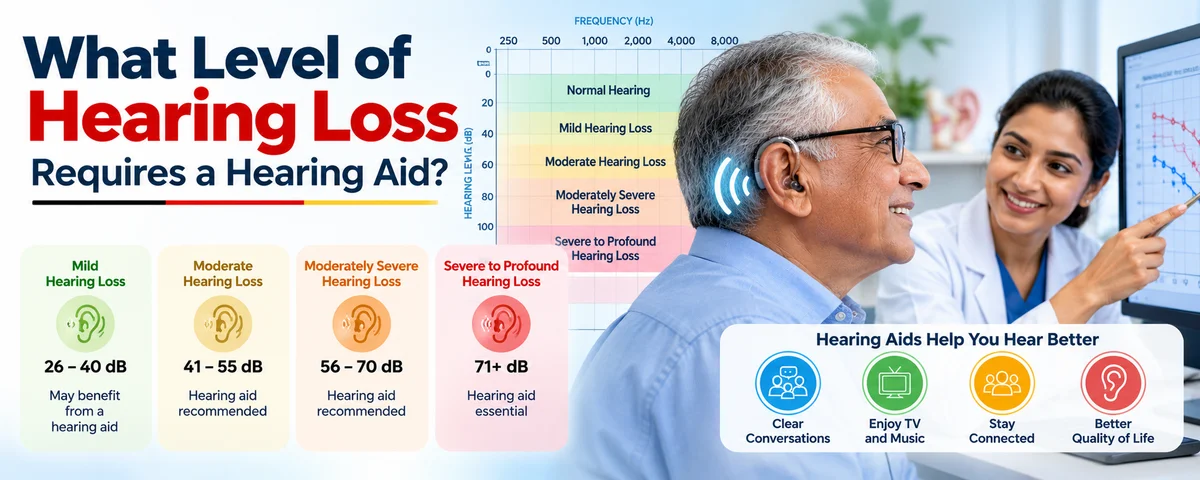
For healthy adults, the normal hearing range in decibels sits between 0 and 25 decibels hearing level across all tested frequencies. When your thresholds fall within this band, your auditory system captures delicate environmental sounds, such as soft rustling leaves, ticking wall clocks, and whispering voices, without amplification. When your plotted responses drop below 25 decibels hearing level, your ears require louder sounds to register them, confirming that an auditory reduction is present.
Understanding frequencies and loudness levels
The horizontal axis of an audiogram represents sound frequency, or pitch, measured in hertz. Low pitches appear on the left side of the graph, starting around 125 to 250 hertz, which aligns with low-pitched sounds such as deep bass notes or thunder. Moving across the graph to the right, frequencies climb through conversational pitches up to 8000 hertz, representing high-pitched sounds such as birdsong, whistles, and crisp consonants.
Human speech is composed of a complex mix of these frequencies. Vowel sounds like "ah," "oh," and "oo" carry most acoustic volume and reside primarily in lower frequencies between 250 and 1000 hertz. In contrast, voiceless consonant sounds like "s," "f," "th," "sh," and "p" reside in higher frequencies between 2000 and 6000 hertz. Consonants carry the critical clarity of spoken language. When high-frequency thresholds drop while low frequencies remain intact, you hear voices clearly enough to know someone is talking, but you cannot separate the words accurately.
Classifying levels of auditory reduction
Clinicians use the plotted thresholds on your audiogram to classify hearing changes into clear functional categories. Mild reductions range between 26 and 40 decibels hearing level, where one-on-one dialogue in quiet spaces remains manageable, but distant voices and soft speech become hard to parse. Moderate reductions sit between 41 and 55 decibels hearing level, making regular conversational speech difficult to comprehend without deliberate volume adjustments or close proximity to the speaker.
Moderately severe reductions encompass 56 to 70 decibels hearing level, requiring raised voices during standard conversations and creating severe communication barriers in social settings. Severe reductions range from 71 to 90 decibels hearing level, where ordinary spoken language becomes inaudible, leaving only loud sounds like shouting, sirens, or heavy machinery detectable. Profound reductions exceed 91 decibels hearing level, where individuals perceive very loud vibrations rather than clear acoustic speech signals, warranting advanced amplification or cochlear solutions.
Hearing Level Category | Decibel Threshold Range (dB HL) | Impact on Daily Communication |
|---|---|---|
Normal Hearing | 0 to 25 dB HL | Effortless understanding of quiet speech, whispers, and delicate environmental sounds. |
Mild Reduction | 26 to 40 dB HL | Difficulty hearing soft voices, whispers, and conversation in noisy background settings. |
Moderate Reduction | 41 to 55 dB HL | Frequent misunderstandings during normal speech; regular need for higher television volumes. |
Moderately Severe | 56 to 70 dB HL | Conversational speech is mostly inaudible unless the speaker speaks loudly at close range. |
Severe Reduction | 71 to 90 dB HL | Inability to hear standard speech; only loud shouts, alarms, and heavy machinery are detected. |
Profound Reduction | 91+ dB HL | Only extremely loud acoustic events or physical vibrations are perceived. |
Preparing for your clinic visit and next steps
Preparing thoughtfully for your appointment helps you maximize the clinical value of your time with the audiologist. Bringing clear notes regarding your personal experiences, listening environments, and health history enables the clinician to match diagnostic testing with practical daily needs. With proper preparation, the appointment becomes a collaborative step toward clearer sound processing and improved daily comfort.
Questions to ask your audiologist
Engaging in an active dialogue during the review of your test results ensures you fully understand your auditory profile. Rather than simply listening to clinical terminology, prepare focused questions that address practical functional impacts. Ask whether your hearing reduction is sensorineural, conductive, or mixed, and find out whether both ears demonstrate identical threshold patterns or distinct differences.
Inquire about how your specific threshold pattern influences your ability to understand speech in challenging environments, such as social gatherings or family meals. Ask whether your symptoms require medical review by an ear, nose, and throat specialist, especially if middle ear fluid, asymmetric scores, or persistent tinnitus are present. Finally, ask what preventative measures you should adopt to safeguard your current auditory levels against further noise-induced damage over the coming years.
Choosing suitable hearing solutions
If your evaluation confirms that amplification would improve your speech understanding and daily comfort, the audiologist will discuss appropriate management pathways. Modern digital hearing aids come in various form factors, including discreet receiver-in-canal devices, behind-the-ear styles, and custom in-the-canal models tailored to individual ear impressions. Selecting the correct style depends on your audiogram configuration, manual dexterity, cosmetic preferences, and daily lifestyle demands.
Consulting an experienced provider helps you review modern capabilities such as directional microphone processing, Bluetooth streaming, rechargeability, and adaptive background noise reduction. You can consult a detailed overview through a hearing aid selection guide to understand how different styles align with individual lifestyles. If travel to a clinical facility is difficult, scheduling a home visit hearing test ensures you receive professional diagnostic attention and personal fitting support without travel stress.
Frequently asked questions
How long does a professional hearing test take?
A professional hearing test typically takes between 30 and 45 minutes from start to finish. This timeframe includes an initial conversation about your lifestyle and medical history, the physical otoscopic examination of your ear canals, the acoustic pure tone and bone conduction tests inside the quiet booth, and speech comprehension checks. The clinician then uses the remaining time to explain your audiogram results and discuss appropriate care recommendations.
Is a hearing test painful or invasive?
A standard hearing test is completely non-invasive and painless. You simply wear comfortable foam earplugs or cushioned over-ear headphones while sitting quietly in a sound-treated room. The clinician introduces soft tones and spoken phrases, and you respond by pressing a button or repeating words. The visual check of your ear canal and middle ear pressure checks involve gentle probe contact that causes no physical discomfort.
What is considered a normal hearing range in decibels?
A normal hearing range in decibels for healthy adults spans from 0 to 25 decibels hearing level across all standard tested frequencies. Falling within this range indicates that you can detect very faint sounds, including gentle whispers, rustling foliage, and quiet breathing. If your softest auditory thresholds consistently register above 25 decibels hearing level, an auditory reduction is present that benefits from professional guidance.
How often should adults get their hearing tested?
Healthy adults benefit from establishing a baseline hearing test and having their hearing re-evaluated every few years to monitor stability. For adults aged 50 and older, annual assessments are recommended to spot age-related auditory changes early. Individuals frequently exposed to loud occupational environments, high recreational noise, or recurring middle ear infections should also schedule yearly clinical evaluations to identify threshold shifts before communication becomes challenging.
What happens after a hearing test confirms auditory reduction?
When an assessment identifies an auditory reduction, the audiologist reviews the results to clarify its severity, type, and daily impact. If the issue stems from a treatable conductive condition like middle ear fluid or wax impaction, a medical referral or clearance is provided. If permanent sensorineural changes are detected, the specialist discusses appropriate hearing technologies, lifestyle communication strategies, or device trials to restore sound clarity.